
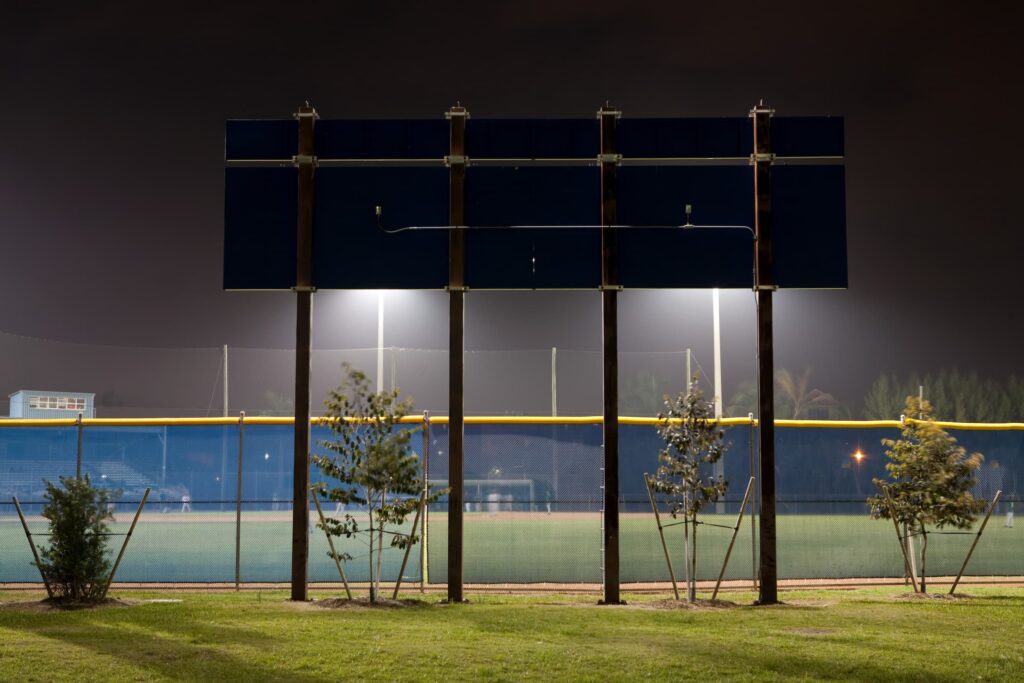
An outdoor LED scoreboard and an indoor scoreboard can look like the same product, one with a bigger price tag. The difference is in what each one is built to handle.
An outdoor board has to stay readable in full sun, stand up to rain and heat, and reach spectators sitting much further away, and each of those adds cost through brighter LEDs, weather sealing and larger digits. An indoor board isn’t built for any of that, so it won’t hold up for long outside.
Outdoor LED Scoreboard Brightness: Stadium Lights vs the Afternoon Sun
Indoors, the problem is reflection. Overhead stadium lighting bounces off a glossy scoreboard face and turns the score into a white smear from the top row. That is why ESA indoor boards use ultra-bright LEDs behind a frosted acrylic front, which eliminates reflections from stadium lights and lets the digits read from every seat.
Outdoors, the problem is the sun itself. An LED that looks bright in a gym disappears against a western sky at 4pm. An outdoor LED scoreboard needs ultra-bright, wide-angle LEDs specified for Australian daylight, plus a frosted, UV stabilised polycarbonate front that cuts reflections from ground lights for night fixtures and does not yellow after three summers.
What a Weatherproof Scoreboard Has to Survive
A weatherproof scoreboard has four jobs. Rain gets in through cable entries and seams, UV degrades plastics and fades digits, coastal air corrodes steel, and a cricket ball or a bored teenager tests the front screen every summer.
ESA outdoor boards answer each of those with a weatherproof, maintenance free enclosure designed for permanent outdoor mounting. An impact resistant, UV stabilised polycarbonate front screen. Powder-coated or galvanised steel framing that stands up to weather and coastal air. Indoor boards need none of this, and that is where much of the price difference lives.
Digit Size and Viewing Distance
Digit size is the biggest driver of scoreboard cost after the choice between a traditional LED digit board and a video screen, and it comes down to how far away your furthest spectator is.
ESA basketball boards use digits of at least 130mm for period indicators, 170mm to 190mm for scores and fouls, and 200mm for game time on the larger models, all readable from the back row of a community stadium.
ESA AFL and cricket boards start at 200mm digits on the AFL240 models for community ovals with the crowd on one side, and 320mm on the AFL300-TM for main ovals with spectators along both wings. Bigger digits mean a bigger enclosure, more LEDs, a heavier mount and a larger footing, which is why an outdoor scoreboard starts where an indoor one finishes.
Control, Power and the Horn
Indoor scoreboards are built around the fast game. Shot clocks that reset from the same controller, team fouls, time-out indicators, and a score bench that puts controller, shot clock reset and horn in one station.
Outdoor scoreboards are built around distance. A wireless controller lets the timekeeper run the board from the clubrooms without a cable trench across the oval, and every ESA outdoor board includes a siren rather than a horn, because the sound has to reach the far pocket. Power is the other question, because outdoor sites may need electrical work to the pole or footing, which is why an itemised quote that includes installation matters more outdoors than in. Fixed, portable and solar options exist for grounds without power at the fence.
What Each One Costs
Indoor traditional LED digit boards start from around $6,000 for a school gym or single community court. Outdoor boards sit further up the range. Compact outdoor-rated boards typically run $8,000 to $15,000, and full-size oval boards and LED video screens (digital scoreboards, if that’s what your committee calls them) run from $15,000 to $50,000 and beyond, depending on digit size, team names and message sign options.
Two things push outdoor cost past the board itself. Installation, because a pole, footing and electrical run are a bigger job than four wall brackets. And the decade after, because weather finds weak components, which is where a board built in Victoria with spare parts on a shelf here (rather than on a ship!) pays for itself.
Can One Board Do Both?
An outdoor scoreboard will work indoors, and it will be oversized, over-bright and over-budget for the room. An indoor scoreboard will not work outdoors for long. The arrangement that does double duty is the shared oval. An outdoor AFL and cricket board like the AFL300-TM scores goals, behinds and points in winter and runs, wickets and overs in summer from the same controller, which lets two clubs share one asset and split the cost.
Five Questions Before You Ask for a Quote
- Where is the furthest spectator, and how far away? That sets digit size before anything else.
- Which sports, all of them? A board that scores footy and cricket, or basketball and netball, is one purchase instead of two.
- Is there power at the mounting point, and who is running it there?
- Who is operating it? A parent volunteer needs a wireless controller with single-button operations and a training session.
- How will it be funded? Grant rounds want an itemised quote with installation included, so ask for that format from day one.
Frequently Asked Questions
What is the difference between an indoor and outdoor LED scoreboard?
Brightness, weatherproofing and size. An outdoor LED scoreboard uses higher-output, wide-angle LEDs to read in direct sun, a weatherproof enclosure with a UV stabilised polycarbonate front, and larger digits, typically 200mm to 320mm, because the crowd is further away. An indoor board uses a frosted acrylic face to beat stadium light glare and smaller digits for a court-sized room.
Can an indoor scoreboard be used outdoors under a roof?
Not for long. A roof keeps rain off the face and does nothing about humidity, UV bouncing in from the side or temperature swings, and the digits are not bright enough for daylight from the open sides.
How bright does an outdoor scoreboard need to be?
Bright enough to read in direct Australian sun at 4pm from the far boundary, from an angle. ESA specifies ultra-bright, wide-angle LEDs for daylight on every outdoor board, with a frosted front that cuts reflections under lights at night.
Are outdoor scoreboards waterproof?
ESA outdoor scoreboards get weather sealing, a maintenance free enclosure designed for permanent outdoor mounting, powder-coated steel frames and an impact resistant, UV stabilised polycarbonate front. They are built to stay outside year-round through rain, storms and coastal air.
How much more does an outdoor scoreboard cost than an indoor one?
Indoor traditional LED digit boards start from around $6,000. Outdoor boards typically run from $8,000 to $15,000 for compact outdoor-rated models and $15,000 to $50,000+ for full-size oval boards and LED video screens. Installation is a larger share of the outdoor bill, so compare quotes that include it.
Indoor court or open oval, tell us the venue. Call Electronic Scoreboards Australia on 1300 023 422 for an itemised, grant-ready quote.